Meta Title: Solar Energy & Solar Street Light Solutions in Cameroon | Unlimitedtechprojects4less
Meta Description: Discover reliable solar energy, solar street light, solar installation, and renewable energy solutions in Cameroon with Unlimitedtechprojects4less.
Focus Keyword: solar street light
Secondary Keywords: solar energy in Cameroon, solar installation Cameroon, solar street lighting, solar panels, solar power systems, solar street lights in Cameroon, renewable energy Cameroon, solar street light installation, off-grid solar systems, commercial solar installation
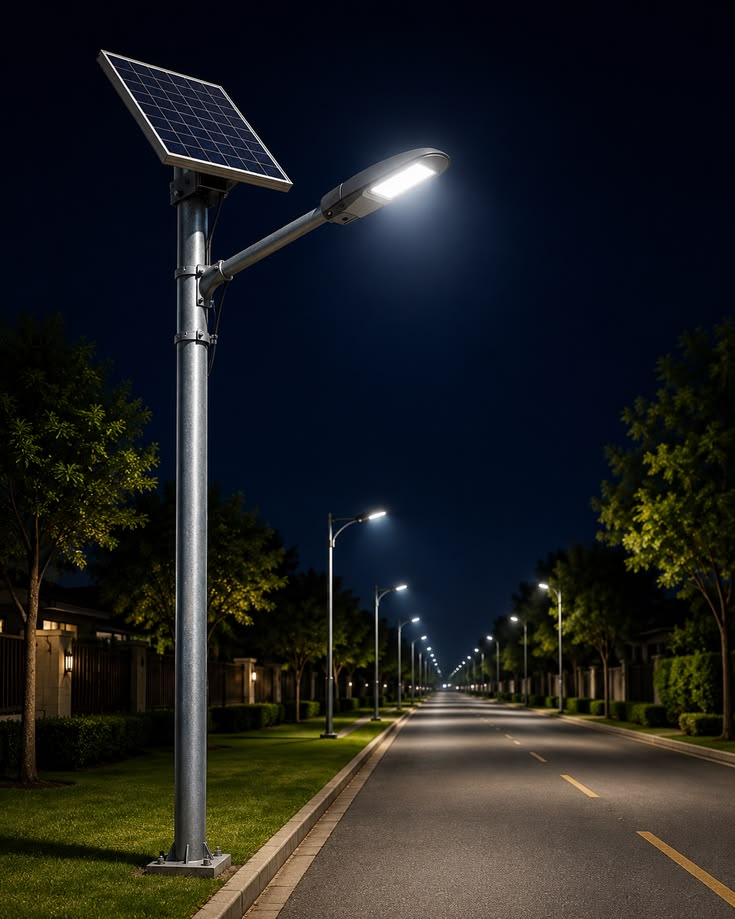
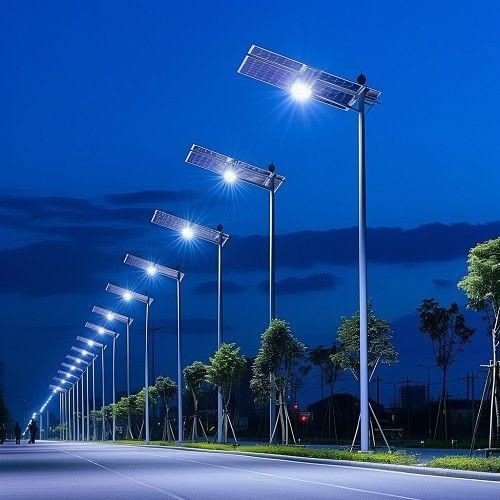
Solar Energy and Solar Street Light: Building a Brighter Future for Cameroon
Cameroon has enormous potential for renewable energy development. With abundant sunlight across much of the country, solar energy presents an important opportunity for households, businesses, industries, institutions, communities, municipalities, and property developers seeking reliable and sustainable energy solutions.
At Unlimitedtechprojects4less Ltd, we believe that solar energy is more than simply installing solar panels on a roof. It is about designing practical energy systems that solve real problems, reduce dependence on conventional electricity sources, improve productivity, and create long-term economic value.
One of the most visible applications of solar technology is the solar street light. From urban roads and residential estates to rural communities, schools, commercial properties, industrial sites, and public spaces, solar street lighting can provide independent illumination without requiring extensive electrical infrastructure.
But solar technology goes far beyond street lighting.
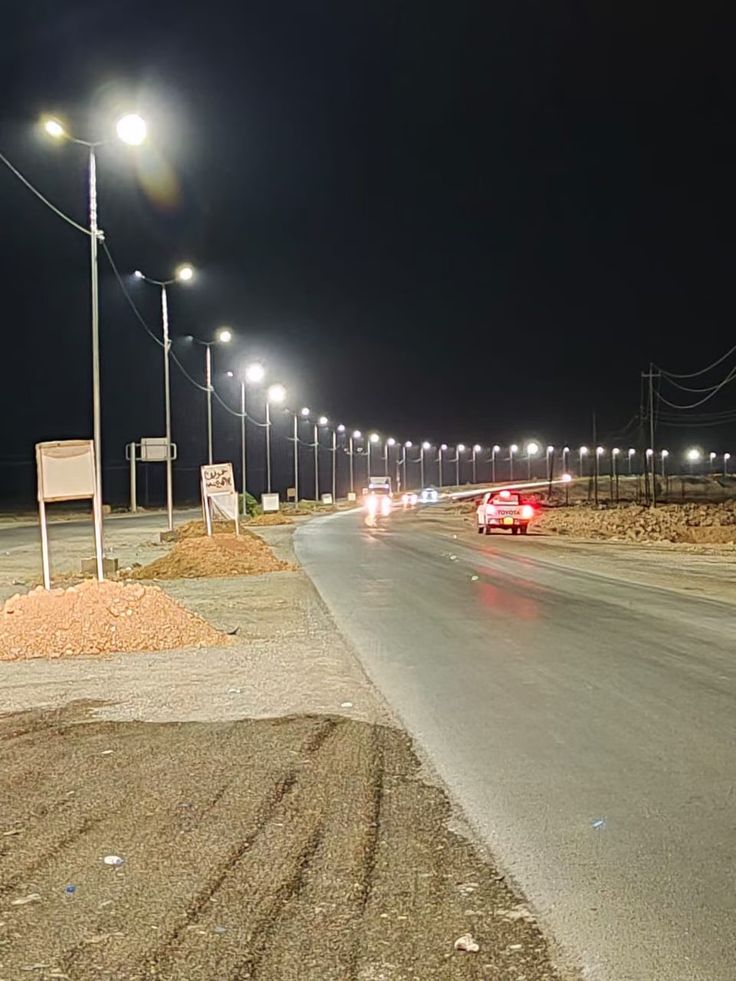
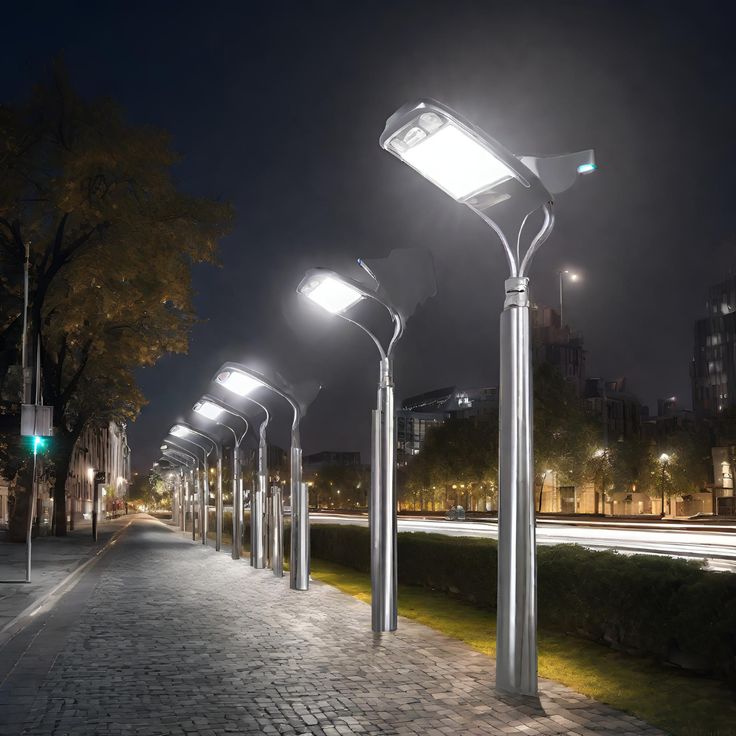
Modern solar solutions can power homes, offices, factories, schools, hospitals, farms, water systems, security installations, telecommunications equipment, commercial buildings, and large-scale infrastructure projects.
This article explores solar energy, solar street light technology, solar installation, system design, batteries, solar panels, applications, benefits, challenges, and the role renewable energy can play in Cameroon and across Africa.
What Is Solar Energy?
Solar energy is energy obtained from the sun and converted into usable electricity or heat.
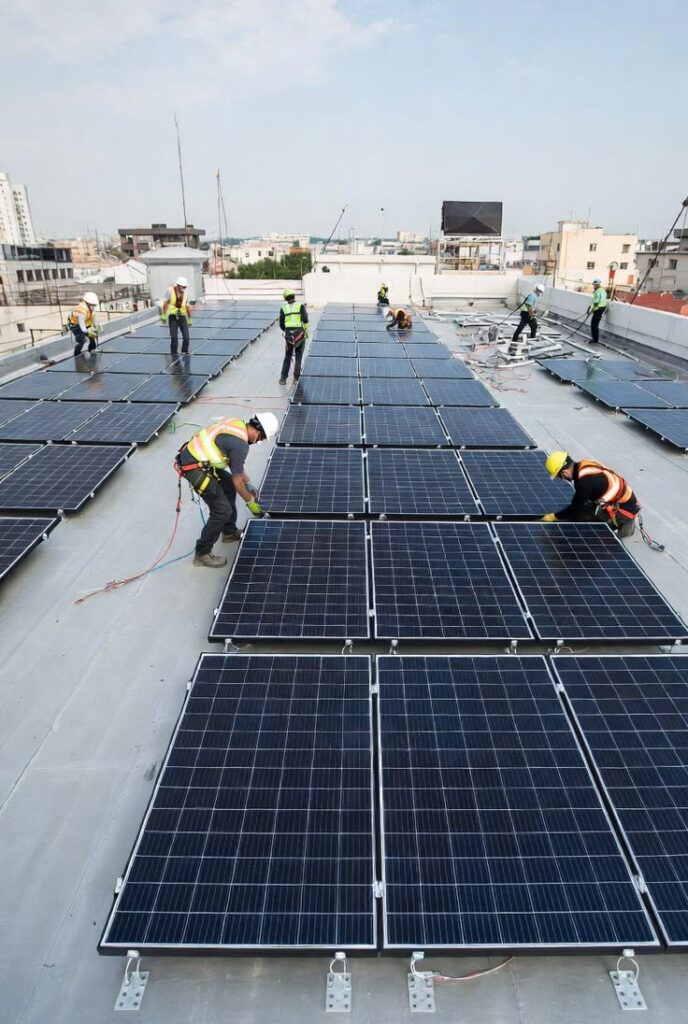
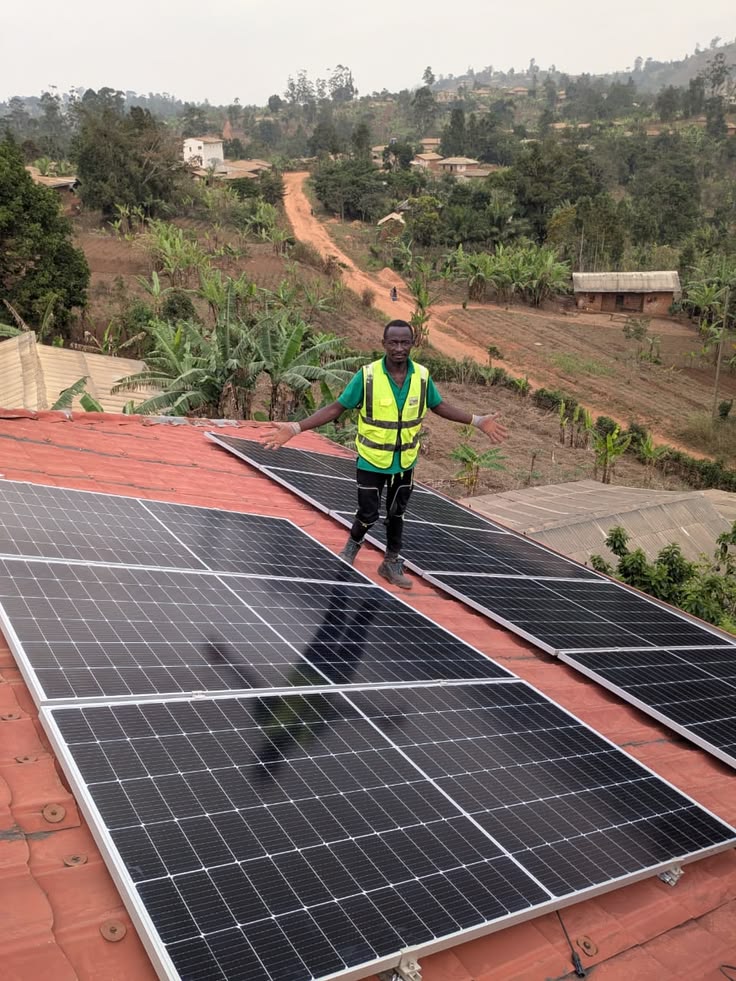
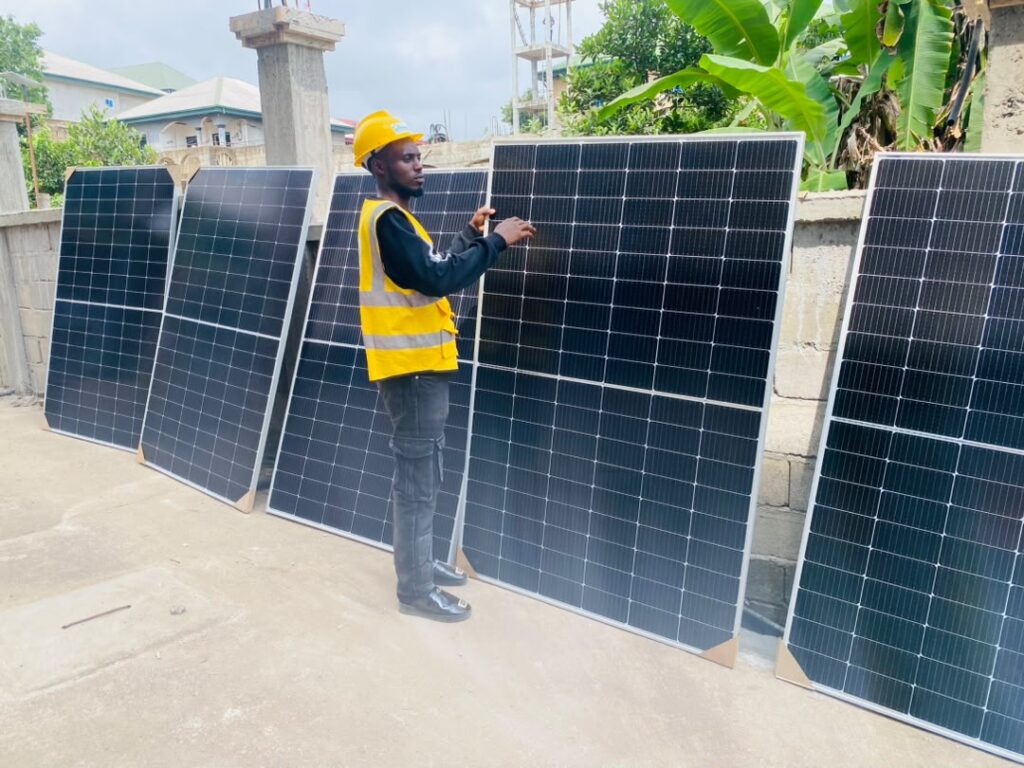
For electricity generation, the most common technology is the photovoltaic (PV) solar panel. Solar panels contain photovoltaic cells that convert sunlight into direct-current electricity. An inverter can then convert that electricity into alternating current for use by conventional electrical appliances.
A complete solar power system may include:
- Solar panels
- Hybrid or off-grid inverter
- Lithium or other battery storage
- Mounting structures
- DC cables
- AC cables
- Protection devices
- Earthing systems
- Monitoring equipment
- Distribution boards
- Charge controllers where applicable
- Automatic transfer equipment
- Solar street lights where outdoor lighting is required
The exact configuration depends on the project’s energy requirements.
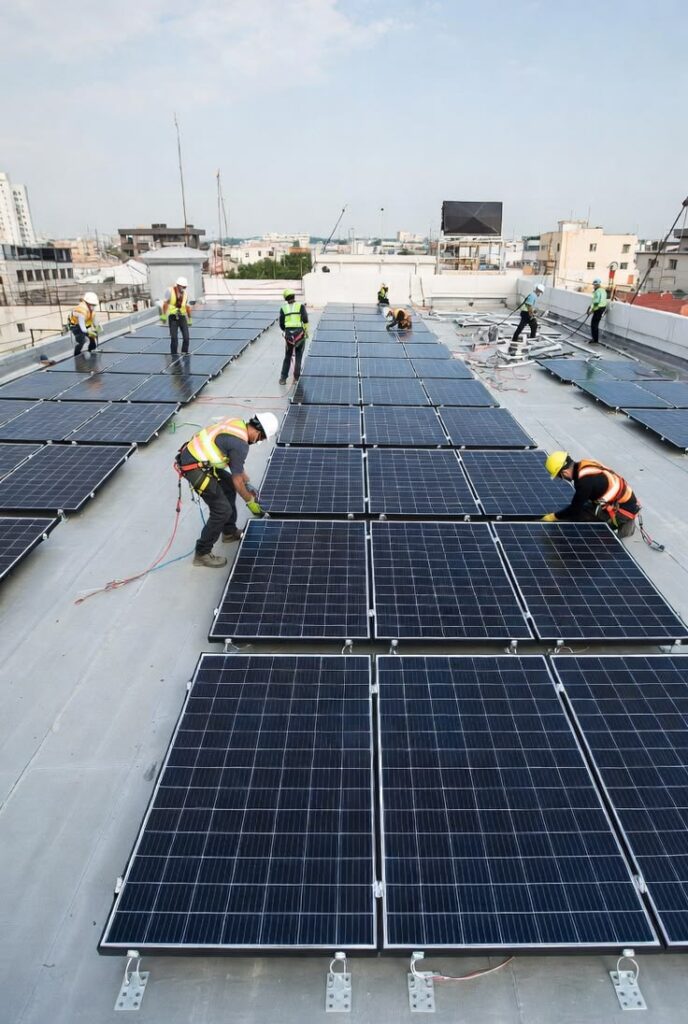
A small residential system, for example, may be designed to power lighting, televisions, refrigerators, fans, computers, and other household appliances.
A commercial or industrial system may require significantly more capacity and may integrate solar generation with the electricity grid, generators, batteries, and sophisticated energy-management equipment.
What Is a Solar Street Light?
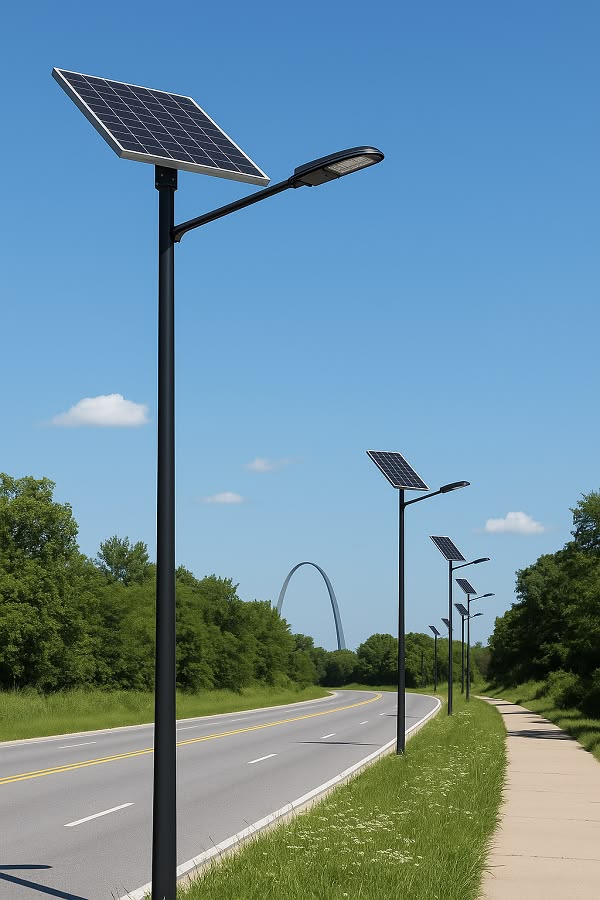
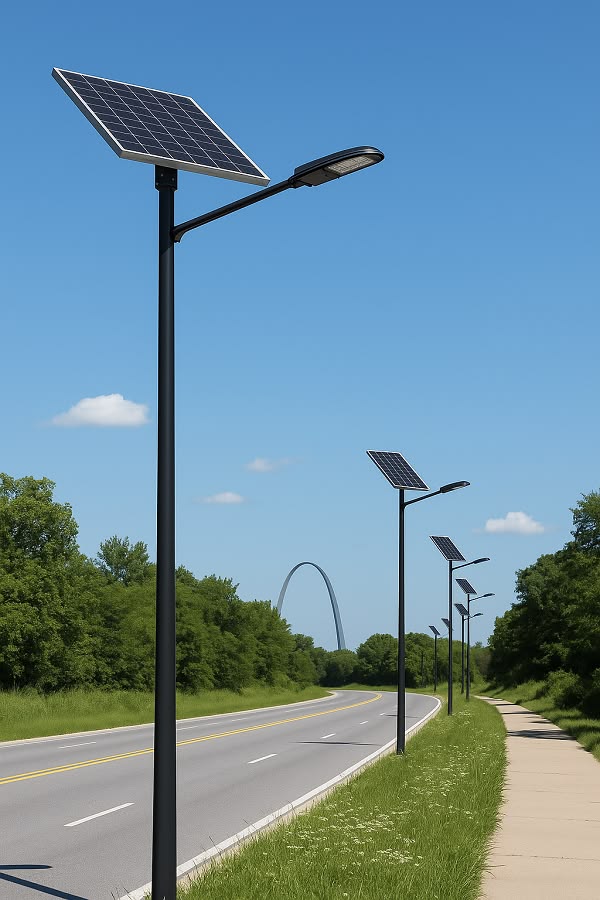
A solar street light is an outdoor lighting system powered primarily by solar energy.
Unlike conventional street lights that depend directly on electricity from the grid, a solar street light generally uses a solar panel to generate electricity during daylight hours. The energy is stored in a battery and used to operate an LED light during the night.
A typical solar street light consists of:
- Solar panel
- LED lighting fixture
- Rechargeable battery
- Solar charge controller
- Lighting control system
- Pole and mounting structure
- Cables and electrical connections
- Optional motion or smart-control sensors
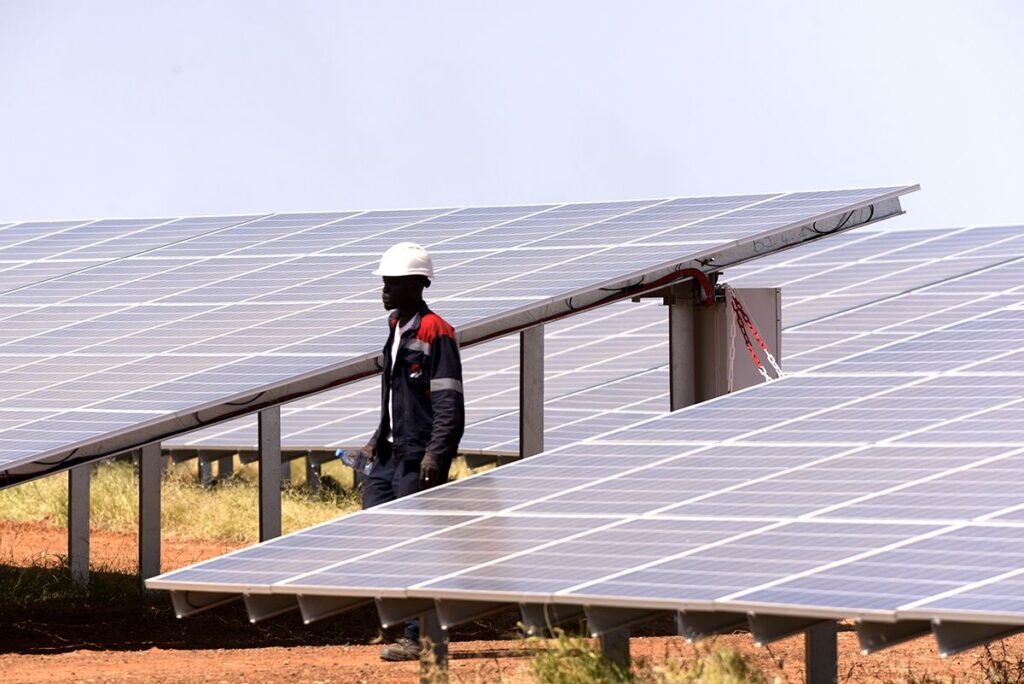
Senegal put into service one of sub-Saharan Africa’s largest solar energy projects Saturday as it pushes to become a regional player in renewables on a continent where the majority remain off-grid. / AFP PHOTO / SEYLLOU
The system can operate independently of the electricity grid, making it particularly useful for roads, estates, communities, campuses, parking areas, farms, construction sites, and locations where grid electricity is unavailable or expensive to extend.
How Does a Solar Street Light Work?
The operation of a solar street light is relatively simple.
During the day
The solar panel receives sunlight and converts solar radiation into electrical energy.
The charge controller manages the energy going into the battery, helping maintain appropriate charging conditions.
The battery stores the energy generated during the day.
At night
The lighting controller detects reduced sunlight and activates the LED lamp.
The stored battery energy powers the LED light throughout the required operating period.
At sunrise
The system detects increasing sunlight and switches the lighting fixture off while the solar panel begins recharging the battery.
This automated process means that many solar street lights can operate without a permanent connection to the electrical grid.
Why Solar Street Light Systems Are Becoming Important in Cameroon
Outdoor lighting is essential for modern communities.
Roads, streets, junctions, markets, schools, residential estates, public spaces, industrial zones, and commercial areas require adequate lighting for visibility and nighttime activities.
However, extending grid electricity to every location can involve significant infrastructure requirements.
This is where the solar street light provides an alternative.
Because solar street lighting can generate and store its own electricity, installations can be made in locations where conventional grid connections are difficult or unavailable.
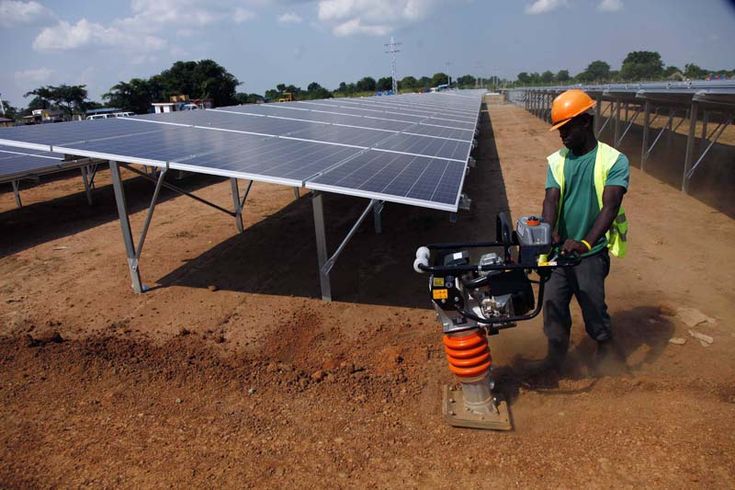
This can be particularly useful for:
- New residential developments
- Rural communities
- Estates
- Secondary roads
- Industrial sites
- Agricultural projects
- Schools
- Universities
- Hospitals
- Hotels
- Shopping areas
- Parking lots
- Construction sites
- Public spaces
- Security perimeters
Benefits of Solar Street Light Installation
1. Reduced Dependence on the Grid
A solar street light can operate independently from the conventional electricity network.
This makes it useful in areas where grid availability is limited or where extending electrical infrastructure to every lighting point would be difficult.
2. Lower Operating Energy Costs
Once properly installed, solar street lights use energy generated from sunlight rather than purchasing electricity continuously for each lighting point.
This can reduce the operating energy requirements associated with conventional grid-powered street lighting.
The economic benefit depends on factors such as:
- Initial installation cost
- Battery life
- Solar irradiation
- Maintenance requirements
- Lighting hours
- Equipment quality
- System design
- Local electricity costs
A professional feasibility assessment should therefore be performed before selecting equipment.
3. Independent Operation
One major characteristic of a solar street light is its ability to function independently.
This is particularly useful for remote roads, estates, farms, campuses, and other developments where grid electricity may not yet be available.
4. Reduced Electrical Infrastructure Requirements
Traditional street lighting can require electrical distribution infrastructure, underground or overhead cables, poles, connections, protection systems, and other components.
Solar street lights can reduce the amount of electrical distribution infrastructure required for each lighting point because electricity is generated locally.
5. Renewable Energy
Solar energy is renewable.
Unlike fossil fuels, sunlight is naturally replenished.
Using solar technology for outdoor lighting can therefore form part of a broader renewable-energy strategy for a property, community, company, or municipality.
6. LED Efficiency
Modern solar street lights commonly use LED lighting technology.
LEDs can provide substantial illumination while consuming relatively little electrical power compared with many older lighting technologies.
The combination of efficient LED lighting, appropriately sized solar panels, and battery storage can create a practical autonomous lighting system.
Solar Street Light Applications
The possibilities for solar street light installation are extensive.
Residential Estates
Property developers can integrate solar street lighting into new housing developments.
Lighting can be installed along:
- Internal roads
- Entrances
- Parking areas
- Pedestrian walkways
- Security zones
- Recreational areas
This can help create a modern infrastructure package for residential developments.
Commercial Properties
Shopping centers, office complexes, business parks, hotels, and commercial premises can use solar street lights for outdoor illumination.
Schools and Educational Campuses
Schools can use solar lighting around:
- Access roads
- Dormitories
- Walkways
- Sports grounds
- Parking areas
- Security perimeters
Industrial Facilities
Industrial sites often require lighting beyond normal building interiors.
Solar street lights can support lighting around:
- Warehouses
- Factory entrances
- Loading zones
- Internal roads
- Storage yards
- Parking areas
Rural Communities
Solar street lighting can be especially useful where grid infrastructure is limited.
A properly designed installation can illuminate community roads and public spaces without requiring every lighting point to be connected to a central electricity network.
Solar Street Light vs Conventional Street Light
The choice between conventional and solar street lighting depends on the specific project.
| Feature | Solar Street Light | Conventional Street Light |
|---|---|---|
| Energy source | Solar energy | Grid/generator electricity |
| Grid connection | Generally not required | Usually required |
| Battery | Usually included | Usually not required at each light |
| Installation | Localized | Requires electrical distribution |
| Remote locations | Highly suitable | Can require additional infrastructure |
| Renewable energy | Yes | Depends on electricity source |
| Maintenance | Panel, battery, LED and electronics | Lamp, electrical infrastructure and related components |
| Initial investment | Can be significant | Varies with infrastructure |
| Long-term operating model | Solar-powered | Electricity-dependent |
Neither technology is automatically appropriate for every location. Proper site assessment is important.
Choosing the Right Solar Street Light
Not every solar street light is suitable for every project.
A professional system design should consider the following factors.
Solar Panel Capacity
The solar panel must generate enough energy to recharge the battery after the required daily lighting operation.
The panel capacity depends on:
- Lighting power
- Daily operating hours
- Solar irradiation
- System losses
- Battery capacity
- Desired autonomy
Battery Capacity
The battery stores solar energy for nighttime operation.
Battery selection should consider:
- Required lighting duration
- Number of consecutive low-sunlight days
- Battery chemistry
- Depth of discharge
- Temperature
- Expected service life
- Maintenance requirements
Lithium-based batteries are increasingly used in modern solar systems because of their energy density, cycle characteristics, and compact design.
LED Power
The LED fixture must provide adequate illumination for the application.
A residential estate road may have different lighting requirements from:
- A major highway
- A factory yard
- A football field
- A parking lot
- A pedestrian walkway
Simply selecting the highest wattage light is not necessarily the correct approach.
The lighting design should consider the required illumination level, road width, pole height, spacing, beam distribution, and surrounding environment.
Solar Street Light Installation Requires Proper Planning
A successful solar street light installation begins before the poles are installed.
The project should be assessed from both an energy and civil-engineering perspective.
Important considerations include:
Site Survey
The installation area should be assessed to determine:
- Road dimensions
- Pole locations
- Available sunlight
- Shading
- Terrain
- Soil conditions
- Drainage
- Existing infrastructure
- Traffic movement
- Pedestrian movement
Solar Resource
Solar panels need adequate exposure to sunlight.
Trees, buildings, mountains, and other structures can create shading that reduces energy production.
Pole Spacing
The spacing between poles should be determined according to the lighting design.
Installing poles too far apart may create dark areas.
Installing them too close together can increase project costs unnecessarily.
Foundation
The pole foundation must be designed for the pole height, soil conditions, wind loads, fixture dimensions, and local site conditions.
This is particularly important in areas exposed to strong winds.
Solar Installation for Homes
Solar street lighting is only one part of a much larger solar industry.
Residential solar systems can help households generate electricity for daily activities.
A properly designed residential solar installation can potentially support loads such as:
- Lighting
- Television
- Refrigerators
- Fans
- Computers
- Internet equipment
- Small pumps
- Kitchen appliances
- Security systems
The system must be sized according to actual electricity consumption.
A household should not select a solar inverter or battery simply based on the number of appliances. The energy consumption, peak demand, operating duration, and future expansion requirements should all be considered.
Solar Installation for Businesses
Businesses often have different energy requirements from residential customers.
A commercial solar installation may be designed for:
- Offices
- Restaurants
- Hotels
- Shops
- Schools
- Clinics
- Warehouses
- Workshops
- Farms
- Manufacturing facilities
- Apartment buildings
Businesses can combine solar panels with battery storage and the electricity grid.
A hybrid solar system can be configured so that the grid supplies electricity when necessary while solar energy and batteries support the facility according to the system design.
Industrial Solar Power Systems
Large industrial facilities can have substantial electricity demand.
Solar can be integrated into industrial energy strategies through systems ranging from rooftop installations to large ground-mounted solar farms.
A large solar project may include:
- Hundreds of solar panels
- Multiple inverters
- Battery energy storage
- Transformer systems
- Protection equipment
- Monitoring systems
- Distribution equipment
- Ground-mounted structures
- Security fencing
- Civil works
- Access roads
Large systems require professional engineering and detailed load analysis.
Solar Battery Storage
Solar panels generate electricity when sunlight is available.
But electricity demand often continues after sunset.
Battery storage solves part of this problem by storing electricity generated during the day for later use.
A battery system can provide:
- Nighttime energy
- Backup power
- Load shifting
- Reduced generator use
- Improved energy independence
Battery sizing should be based on the required energy rather than simply choosing a large battery.
For example, a project requiring 20 kWh of usable nighttime energy has different battery requirements from one requiring 100 kWh or 500 kWh.
Solar Energy and Generators
Solar energy does not necessarily have to replace generators completely.
In many commercial and industrial environments, a hybrid strategy can combine:
Solar + Battery + Grid + Generator
Each source can perform a different function.
Solar can supply daytime energy.
Batteries can provide stored energy.
The grid can supplement energy requirements.
A generator can provide backup during prolonged periods of low solar production or grid outages.
The appropriate configuration depends on the project’s load profile and reliability requirements.
Solar Street Light Maintenance
Although solar street lights can reduce dependence on grid electricity, they still require maintenance.
Important maintenance activities include:
- Cleaning solar panels
- Checking battery performance
- Inspecting LED fixtures
- Checking cable connections
- Inspecting poles
- Checking foundations
- Testing control systems
- Inspecting charge controllers
- Checking for corrosion
- Removing vegetation that creates shading
Preventive maintenance can help identify problems before they become major failures.
Common Solar Street Light Problems
Poorly designed or poorly installed systems can experience problems such as:
Short Nighttime Operation
This can occur when the battery or solar panel is undersized, the battery has degraded, or the system experiences inadequate solar charging.
Reduced Brightness
Possible causes include:
- LED degradation
- Battery problems
- Controller faults
- Poor electrical connections
- Incorrect system configuration
Poor Solar Charging
Possible causes include:
- Panel shading
- Dirt accumulation
- Incorrect orientation
- Damaged panels
- Faulty charge controllers
Premature Battery Failure
Battery life can be affected by:
- Excessive depth of discharge
- High temperatures
- Poor charging
- Low-quality batteries
- Incorrect system sizing
Professional installation and appropriate equipment selection are therefore important.
Solar Street Light for Property Development
Property development and renewable energy can work together.
A new residential estate, commercial complex, or industrial park can incorporate solar energy from the beginning of the project.
For example, a property development could include:
- Solar street lights
- Rooftop solar
- Battery storage
- Solar-powered security systems
- Solar water pumping
- Solar perimeter lighting
- Energy-efficient buildings
This approach allows energy infrastructure to become part of the overall project design rather than being added as an afterthought.
Solar Energy for Water Pumping
Solar power can also be used for water systems.
Solar-powered water pumping can support:
- Boreholes
- Agricultural irrigation
- Community water supply
- Livestock watering
- Residential water systems
- Industrial water requirements
A solar water-pumping system must be designed according to the pump power, pumping head, water requirement, operating hours, borehole characteristics, and solar resource.
Solar Energy for Agriculture
Cameroon has significant agricultural activity, creating opportunities for solar-powered infrastructure.
Solar systems can support:
- Irrigation
- Water pumping
- Cold storage
- Farm lighting
- Security systems
- Processing equipment
- Electric fencing where appropriate
- Agricultural monitoring systems
Solar-powered irrigation, for example, can provide water during daylight hours without requiring continuous generator operation.
Solar Energy for Schools and Institutions
Educational institutions can benefit from solar energy for both electricity and outdoor lighting.
A school solar project can potentially combine:
Solar PV + Battery Storage + Solar Street Light + Energy-Efficient Appliances
This can support classrooms, administrative buildings, laboratories, computer rooms, accommodation facilities, security systems, and outdoor areas.
Solar street lights can also improve nighttime visibility around campuses when properly designed and installed.
Solar Energy and Infrastructure Development
Modern infrastructure requires reliable energy.
Roads, estates, schools, hospitals, industrial parks, markets, water facilities, and public infrastructure all require electricity.
Solar energy can therefore be integrated into infrastructure development at different scales.
For example:
Road Project
Road construction → drainage → street lighting → solar street lights → security infrastructure.
Residential Development
Land development → roads → drainage → buildings → solar energy → solar street lighting → water systems.
Industrial Development
Land preparation → factory → warehouse → electrical infrastructure → solar PV → battery storage → outdoor solar lighting.
This integrated approach can help developers consider energy requirements during the planning stage.
Solar Street Light as Part of Smart Infrastructure
The future of solar street lighting is not limited to simply turning a lamp on at night.
Modern systems can incorporate smart technology.
Potential features include:
- Remote monitoring
- Motion sensors
- Automatic dimming
- Energy monitoring
- Fault alerts
- Remote configuration
- Communication systems
- Smart-city integration
For example, a solar street light could operate at a lower lighting level when there is little movement and increase illumination when pedestrians or vehicles are detected.
Such systems can potentially reduce energy consumption while maintaining appropriate lighting conditions.
Solar Street Light and Community Development
Reliable outdoor lighting can form part of broader community infrastructure projects.
A community development project may combine:
- Roads
- Drainage
- Water supply
- Solar street lights
- Schools
- Health facilities
- Public spaces
- Commercial facilities
Solar street lighting can therefore be considered as one component of a larger development strategy.
How Much Does Solar Street Light Installation Cost in Cameroon?
There is no single price for a solar street light installation.
The final project cost depends on the specification and location.
Factors include:
- Solar panel capacity
- LED wattage
- Battery capacity
- Pole height
- Pole material
- Foundation requirements
- Lighting spacing
- Number of lights
- Transport
- Installation labor
- Civil works
- Control systems
- Monitoring equipment
- Project scale
A small standalone solar street light for a pedestrian area will have very different requirements from a major road-lighting project involving hundreds of poles.
For accurate budgeting, the project should first undergo a technical assessment.
Why Professional Solar System Design Matters
Solar technology is often presented as simple because solar panels themselves are relatively straightforward.
However, a successful solar project requires much more than purchasing panels and connecting them to an inverter.
Professional design should consider:
- Load analysis
- Solar resource
- Battery requirements
- Inverter capacity
- Cable sizing
- Protection
- Earthing
- Structural design
- Installation conditions
- Future expansion
- Maintenance
- Safety
Incorrect sizing can lead to poor performance, equipment failure, unnecessary expenditure, or inadequate power supply.
Solar Energy for the Future of Cameroon
Cameroon’s energy future can involve multiple sources of electricity.
Hydropower, solar, thermal generation, biomass, and other technologies can all have roles depending on location and application.
Solar energy is particularly attractive for distributed applications because it can be deployed at different scales.
A household can install a small solar system.
A company can install a commercial rooftop system.
A developer can build a solar-powered estate.
A municipality can deploy solar street lights.
An industrial company can install a large solar farm with battery storage.
This scalability is one of the major characteristics of solar technology.
Our Approach to Solar Projects
At Unlimitedtechprojects4less Ltd, our approach is centered on connecting ideas, technical expertise, resources, and project execution.
From initial consultation to implementation, a solar project should be treated as an engineering and investment decision.
Our project process can include:
1. Consultation
We discuss the client’s objectives, location, existing energy sources, challenges, and expected outcomes.
2. Site Assessment
The project location and infrastructure are assessed.
3. Load Assessment
Electrical loads are identified and analyzed.
4. System Design
The solar panels, inverter, battery, protection systems, mounting structures, cables, and other components are selected according to project requirements.
5. BOQ and Cost Estimation
A Bill of Quantities can be developed to establish the materials, quantities, labor, transportation, and associated costs.
6. Installation
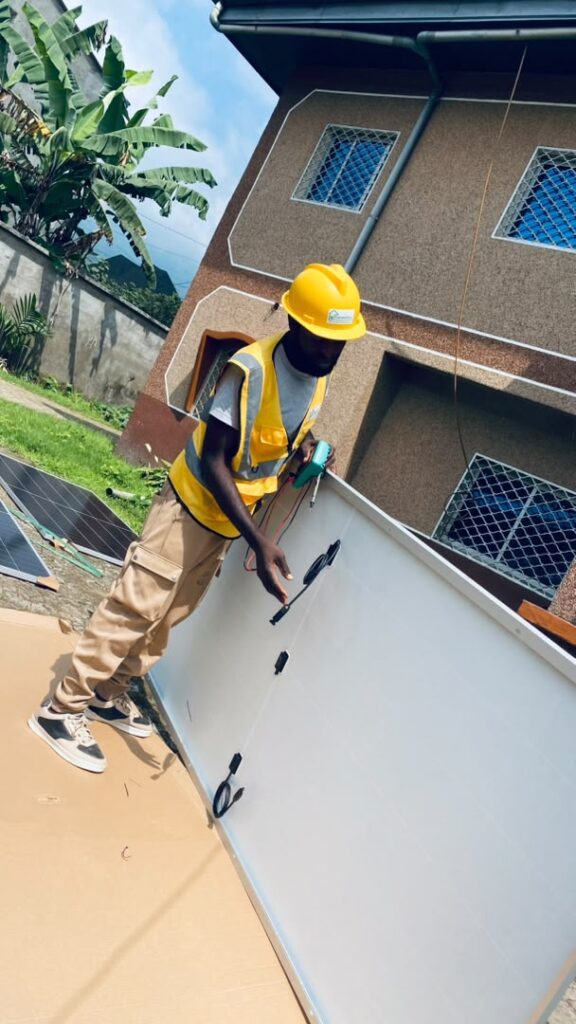
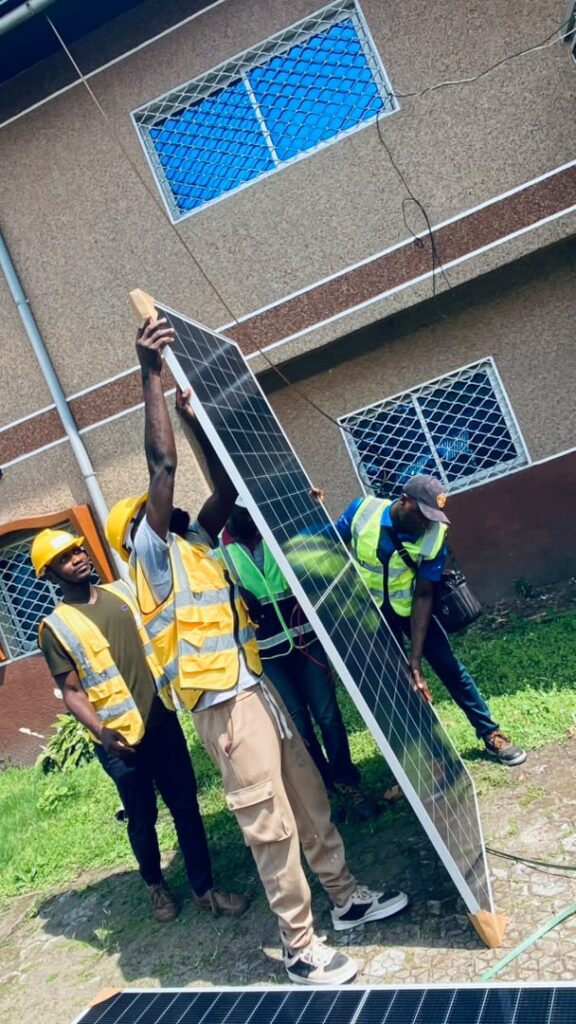
Qualified technical teams install and configure the system.
7. Testing and Commissioning
The completed system is tested to verify operation.
8. Maintenance
Periodic inspection and maintenance can help preserve system performance.
Solar Street Light Projects for Developers
Developers planning new estates should consider outdoor lighting during the early stages of development.
Instead of waiting until buildings are completed, developers can integrate solar street lights into the master plan.
This allows the project team to determine:
- Road widths
- Pole locations
- Lighting coverage
- Solar exposure
- Electrical requirements
- Drainage conflicts
- Foundation locations
- Pedestrian areas
- Parking areas
The result can be a more coordinated infrastructure design.
Solar Street Light for Construction Sites
Construction sites require temporary lighting for security and operations.
Portable or temporary solar lighting systems can provide illumination for:
- Site entrances
- Storage areas
- Workers’ access routes
- Equipment yards
- Security points
- Material storage zones
Because solar lighting does not necessarily require a permanent grid connection, it can be useful during early construction stages before permanent electrical infrastructure is completed.
Solar Street Light for Security
Lighting and security are closely connected.
Adequate outdoor illumination can improve visibility around:
- Gates
- Fences
- Parking areas
- Warehouses
- Industrial compounds
- Residential estates
- Construction sites
Solar street lights can provide independent lighting at security-sensitive locations.
However, lighting should be combined with appropriate security measures rather than treated as a standalone security solution.
The Importance of Quality Solar Equipment
The performance of a solar project depends heavily on component quality.
Important equipment categories include:
Solar Panels
Panel efficiency, power rating, durability, warranty, and environmental performance should be considered.
Inverters
The inverter must be appropriately sized for both continuous and peak loads.
Batteries
Battery chemistry, usable capacity, cycle life, operating temperature, and warranty should be evaluated.
LED Fixtures
The lighting fixture should provide the required illumination and withstand outdoor environmental conditions.
Poles
Pole dimensions, structural strength, corrosion resistance, and foundation design are important.
Protection Equipment
Appropriate electrical protection and earthing are essential for safe operation.
Solar Is an Investment in Infrastructure
Solar energy should not only be viewed as an electrical appliance purchase.
It can be treated as infrastructure.
For property developers, businesses, institutions, and communities, the objective is to create an energy system that supports productive assets.
A well-designed solar project can become part of:
Real Estate + Construction + Infrastructure + Energy + Technology
This integrated approach is particularly relevant for large development projects.
Solar Energy and Economic Value
The value of a solar project is not limited to the electricity it generates.
Reliable energy can support economic activities.
Electricity can enable:
- Businesses to operate
- Schools to teach
- Water systems to function
- Offices to work
- Factories to produce
- Security systems to operate
- Residential buildings to function
- Roads and public areas to remain illuminated
Solar street lights similarly form part of the infrastructure required to develop functioning communities and commercial environments.
Frequently Asked Questions About Solar Street Light
What is a solar street light?
A solar street light is an outdoor lighting system that uses solar energy to generate electricity during the day, stores the energy in a battery, and uses it to power an LED light at night.
Does a solar street light need electricity from the grid?
Most standalone solar street lights are designed to operate without a grid connection.
How long can a solar street light operate at night?
The operating duration depends on battery capacity, solar panel capacity, LED power, weather conditions, lighting controls, and system design.
Can solar street lights work during rainy weather?
Yes, but performance depends on the energy stored in the battery and the amount of solar energy available for recharging. Proper system sizing should account for periods of reduced sunlight.
Can solar street lights be installed in residential estates?
Yes. They can be designed for internal roads, walkways, entrances, parking areas, and other outdoor spaces.
Can solar street lights be used for highways?
Solar street lights can be used for different road types, but highway projects require proper lighting engineering, structural design, traffic considerations, pole spacing, and appropriate equipment.
Do solar street lights require maintenance?
Yes. Periodic inspection and maintenance are recommended.
Can solar street lights have motion sensors?
Yes. Some modern systems can incorporate motion sensors and intelligent lighting controls.
Can solar energy power a whole house?
Yes, depending on the system design and the home’s electricity demand. The required solar capacity, inverter, and battery storage must be calculated from the actual loads.
Can solar power be combined with grid electricity?
Yes. Hybrid systems can combine solar PV, battery storage, and grid electricity.
Choosing a Solar Partner in Cameroon
A solar project should begin with the question:
What problem are we trying to solve?
For a homeowner, the objective may be backup electricity.
For a business, it may be energy cost management and reliability.
For an estate developer, it may be integrated energy infrastructure.
For a municipality, it may be road and public-area lighting.
For an agricultural project, it may be water pumping.
For an industrial facility, it may be large-scale energy generation and storage.
The technology should follow the project requirement.
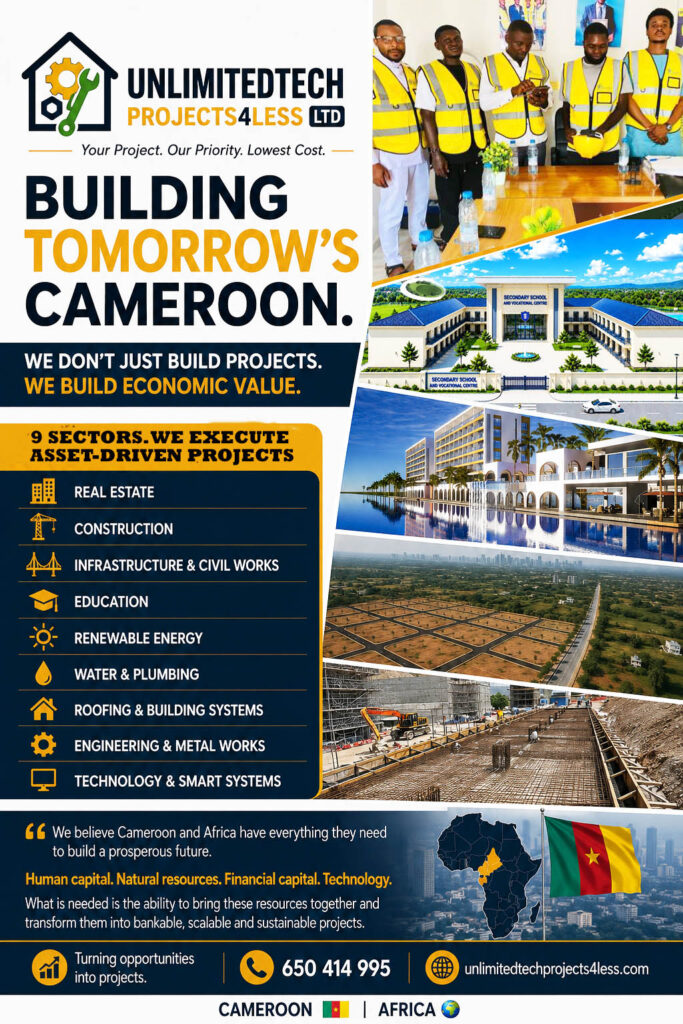
At Unlimitedtechprojects4less Ltd, our objective is to connect clients with the technical solutions, resources, and execution capabilities required to transform project ideas into functional assets.
Conclusion: Building a Solar-Powered Future
Solar energy is becoming an increasingly important component of modern infrastructure.
From a single residential solar panel system to a large commercial solar farm, the technology can be adapted to different applications.
The solar street light is one of the clearest examples of how solar technology can be integrated directly into infrastructure. By combining solar panels, batteries, LED lighting, smart controls, and appropriately designed poles, communities and property developments can create independent outdoor lighting systems.
But the opportunity is much larger.
Solar energy can support homes, businesses, industries, schools, hospitals, farms, water systems, construction sites, residential estates, commercial developments, and infrastructure projects.
For Cameroon and Africa, the opportunity is to move beyond simply consuming energy and increasingly invest in systems that generate, store, and intelligently manage energy.
At Unlimitedtechprojects4less Ltd, we believe that successful development requires the ability to bring together land, human capital, natural resources, financial capital, engineering, and technology and transform them into productive and sustainable projects.
We don’t just build projects. We build economic value.
Whether you need a residential solar installation, commercial solar system, solar water-pumping solution, large-scale solar project, or solar street light installation, proper planning and professional system design are the foundation of a successful project.
Ready to discuss your solar project?
Unlimitedtechprojects4less Ltd
Your Project. Our Priority. Lowest Cost.
Solar Energy • Solar Installation • Solar Street Light • Infrastructure • Engineering • Construction • Renewable Energy
Serving Cameroon and supporting projects across Africa.
#SolarStreetLight #SolarEnergyCameroon #SolarInstallationCameroon #SolarStreetLighting #SolarPanels #SolarPower #RenewableEnergy #SolarEnergy #SolarInstallation #Cameroon #SolarProjects #SolarLighting #CleanEnergy #OffGridSolar #HybridSolarSystem #SolarPowerSystem #SustainableDevelopment